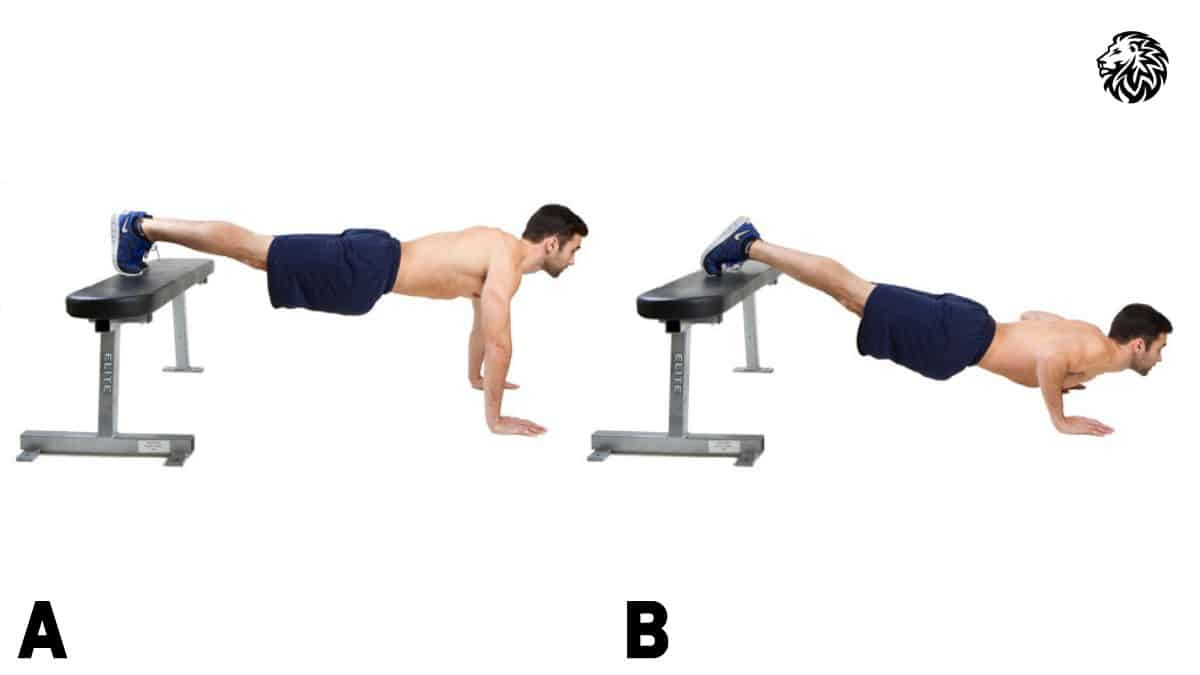
A decline push-up strengthens your upper body using bodyweight resistance and a simple elevation under your feet. By placing your feet on a bench, box, or step, you shift more tension into your upper chest and front shoulders. This variation suits beginners who want to progress past standard push-ups and experienced lifters who want to add more challenge without equipment. With the right form, a decline push-up builds strength, stability, and control in one efficient movement.
Exercise Instructions
Follow these steps to perform a decline push-up with confidence:
- Set Up Your Surface
Choose a stable object like a bench, sturdy step, or low box. The height should feel comfortable enough that you can maintain full control of your body from start to finish. - Position Your Body
Place your feet on the surface and walk your hands forward until your body forms a straight line from heels to head. Your hands should sit slightly wider than shoulder-width. - Brace Your Core
Keep your abdomen tight, legs straight, and hips aligned. A strong core prevents sagging or arching through the lower back. - Lower Your Body
Bend your elbows and lower your chest toward the floor while keeping your elbows angled about 45 degrees from your body. Move slowly to stay in control. - Press Up to the Start Position
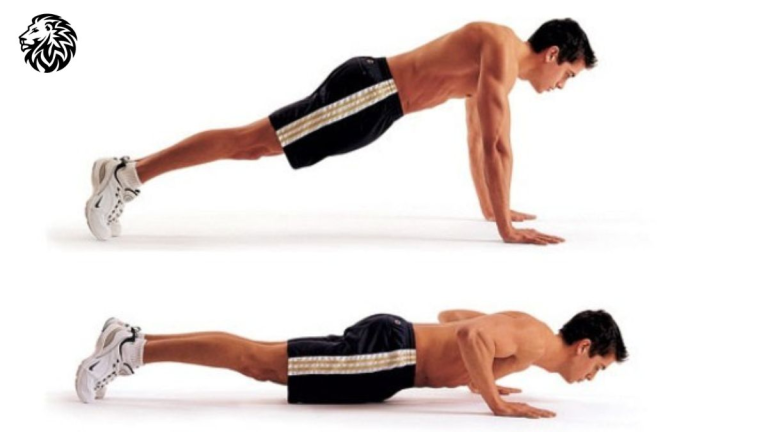
Push through your palms and extend your arms until you return to the starting plank position. Keep your hips level throughout the movement. - Repeat for Your Chosen Reps
Maintain steady breathing and smooth tempo during each rep to help your form stay consistent.
Muscles Targeted
A decline push-up engages several major upper-body muscles:
- Upper Chest (Clavicular Pectoral Fibers): The decline angle shifts emphasis to the top portion of the chest.
- Front Shoulders (Anterior Deltoids): These muscles support the press and stabilize the shoulder joint.
- Triceps: They extend the arms during the upward phase.
- Core Muscles: The abdominals, obliques, and lower back work together to hold a rigid plank position.
- Upper Back Stabilizers: These muscles help you maintain shoulder alignment and prevent collapse in the torso.
Why This Exercise is Important
The decline push-up challenges your upper body in a way that standard push-ups cannot. The elevated foot position increases the load on your chest and shoulders, encouraging better strength development. It also teaches stronger body control and improves core stability. This makes it a valuable progression for anyone working toward harder push-up variations, handstand push-ups, or stronger pressing power. In addition, because it requires minimal equipment, you can add it to nearly any training routine without much setup.
Tips and Things to Avoid
Use these tips to stay safe and improve your results with each session:
- Start with a Lower Surface if you are new to this variation. A small step or sturdy yoga block can help you learn the movement before using a higher bench.
- Keep Your Hips Level throughout each rep. Dropping the hips places stress on the lower back.
- Avoid Flaring Your Elbows too wide. This strains the shoulders and reduces chest engagement.
- Press Through the Full Range of Motion rather than rushing through reps. Controlled movements build strength more effectively.
- Keep Your Neck in a Neutral Position. Look slightly ahead of your hands to avoid straining your neck.
- Do Not Let Your Shoulders Shrug Upward. Pull them back and down to stay stable.
Reps and Sets
| Training Goal | Reps | Sets | Rest |
|---|---|---|---|
| Strength | 6–10 | 3–5 | 90 seconds |
| Muscle Growth | 8–15 | 3–4 | 60–90 seconds |
| Endurance | 12–20 | 2–3 | 45–60 seconds |
Other Exercises to Use
Pair the decline push-up with these movements to build balanced upper-body strength:
- Standard Push-Ups: Help maintain good baseline pressing strength and endurance.
- Incline Push-Ups: Ideal for warming up the chest and reinforcing technique.
- Dumbbell Bench Press: Adds load for more strength development.
- Chest Dips: Increase triceps and lower chest strength.
- Pike Push-Ups: Strengthen the shoulders and prepare you for vertical pressing.
- Planks: Improve core control, which carries over directly to decline push-ups.
Final Thoughts
A decline push-up works well for anyone who wants to increase upper-body strength using minimal equipment. This variation pushes your chest and shoulders harder than a regular push-up while building a stronger core at the same time. Consistent practice improves stability, technique, and strength in a practical and accessible way. Add this movement into your routine and progress gradually by adjusting elevation or reps to keep challenging your muscles.
Frequently Asked Questions
How high should my feet be for a decline push-up?
Start with a low surface such as a step or small box. As your strength improves, gradually increase the height, keeping full control at every level.
Do decline push-ups build the upper chest?
Yes. The angle created by elevating your feet places more emphasis on the upper chest.
Are decline push-ups harder than regular push-ups?
They require more strength in the chest, shoulders, and core. Most people find them more challenging than standard push-ups.
Can beginners try decline push-ups?
Yes. Using a very low surface allows beginners to practice the movement safely.
How often should I do decline push-ups?
Two to three sessions per week work well for most training routines. Rest at least one day between sessions that target the same muscle groups.